Tavex uses cookies to ensure website functionality and improve your user experience. Collecting data from cookies helps us provide the best experience for you, keeps your account secure and allows us to personalise advert content. You can find out more in our cookie policy.
Please select what cookies you allow us to use
Cookies are small files of letters and digits downloaded and saved on your computer or another device (for instance, a mobile phone, a tablet) and saved in your browser while you visit a website. They can be used to track the pages you visit on the website, save the information you enter or remember your preferences such as language settings as long as you’re browsing the website.
Cookie usage
Necessary cookies
| Cookie name | Cookie description | Cookie duration |
|---|---|---|
| tavex_cookie_consent | Stores cookie consent options selected | 60 weeks |
| tavex_customer | Tavex customer ID | 30 days |
| wp-wpml_current_language | Stores selected language | 1 day |
| AWSALB | AWS ALB sticky session cookie | 6 days |
| AWSALBCORS | AWS ALB sticky session cookie | 6 days |
| NO_CACHE | Used to disable page caching | 1 day |
| PHPSESSID | Identifier for PHP session | Session |
| latest_news | Helps to keep notifications relevant by storing the latest news shown | 29 days |
| latest_news_flash | Helps to keep notifications relevant by storing the latest news shown | 29 days |
| tavex_recently_viewed_products | List of recently viewed products | 1 day |
| tavex_compare_amount | Number of items in product comparison view | 1 day |
Preference cookies
| Cookie name | Cookie description | Cookie duration |
|---|---|---|
| chart-widget-tab-*-*-* | Remembers last chart options (i.e currency, time period, etc) | 29 days |
| archive_layout | Stores selected product layout on category pages | 1 day |
Targeting cookies
| Cookie name | Cookie description | Cookie duration |
|---|---|---|
| cartstack.com-* | Used for tracking abandoned shopping carts | 1 year |
| _omappvp | Used by OptinMonster for determining new vs. returning visitors. Expires in 11 years | 11 years |
| _omappvs | Used by OptinMonster for determining when a new visitor becomes a returning visitor | Session |
| om* | Used by OptinMonster to track interactions with campaigns | Persistent |
Analytical cookies
| Cookie name | Cookie description | Cookie duration |
|---|---|---|
| _ga | Used to distinguish users | 2 years |
| _gid | Used to distinguish users | 24 hours |
| _ga_* | Used to persist session state | 2 years |
| _gac_* | Contains campaign related information | 90 days |
| _gat_gtag_* | Used to throttle request rate | 1 minute |
| _fbc | Facebook advertisement cookie | 2 years |
| _fbp | Facebook cookie for distinguishing unique users | 2 years |

Historical Sovereigns: Buying Gold Coins in the UK
Published by Ashleigh Dowman in category Market News on 14.08.2026
Gold price (XAU-GBP)
3,137.37 GBP/oz
- GBP20.71
Silver price (XAG-GBP)
44.63 GBP/oz
- GBP1.06
Historical Sovereigns: Buying Gold Coins in the UK
If you have ever looked into buying physical gold in the UK, you have almost certainly come across the gold sovereign. It is Britain’s most famous coin, one of the most recognised gold coins in the world, and one of the few physical assets that combines real history with real investment value.
But not every sovereign is the same. The historical sovereigns struck under Queen Victoria and King George V offer something modern issues cannot match. They carry the weight of history in the most literal sense.
This guide covers everything you need to know about historical gold sovereigns, why they matter, what makes each era different, and what UK investors should know before buying.
What is a gold sovereign?
The gold sovereign is the oldest gold coin still made in the world. King Henry VII authorised the first sovereign to be struck in 1489, weighing almost half a troy ounce in near-24 karat gold. Those early coins were too pure and valuable for daily trade, so they were instead given as gifts to visiting dignitaries and high-ranking officials.
Over the centuries, the specifications changed. By 1817, the sovereign had settled into the form most investors know today: 22 karat gold, weighing exactly 7.98805 grams, with 7.32238 grams of fine gold and a fineness of 916.7. That standard has remained almost unchanged ever since.
Every gold sovereign minted after 1837 is legal tender in the UK. That legal tender status is not just historical. It has a direct and important practical benefit for UK investors: any gold sovereign is exempt from Capital Gains Tax, no matter the profit made on its sale. That exemption applies to Victorian sovereigns, George V sovereigns, and modern sovereigns alike.
They are also exempt from VAT as investment gold. Between the CGT exemption and VAT-free status, the sovereign is one of the most tax-efficient physical assets available to UK investors.
You can browse the full range of historical sovereigns available at Tavex Bullion or check the live gold price before you buy.
The Queen Victoria Gold Sovereign (1837 to 1901)
Who was Queen Victoria?
Queen Victoria was born in London in 1819 and crowned at the age of 18. Her reign lasted almost 64 years, making it one of the longest in British history.
It was a period of major change. The expansion of the railways and the introduction of the steamship opened up global trade. Telephones, telegraphs, and early automobiles changed how the world communicated. London became the financial capital of the world, and the British Empire reached its greatest extent, covering almost a quarter of the earth’s land area and nearly half a billion people.
Victoria ruled as a constitutional monarch, so her powers were limited, but she remained head of the largest empire in human history. By almost any measure, she was the most powerful woman of her era. Her reign ended in 1901 when she died, and her eldest son Edward VII took the crown.
The three versions of the Victorian sovereign
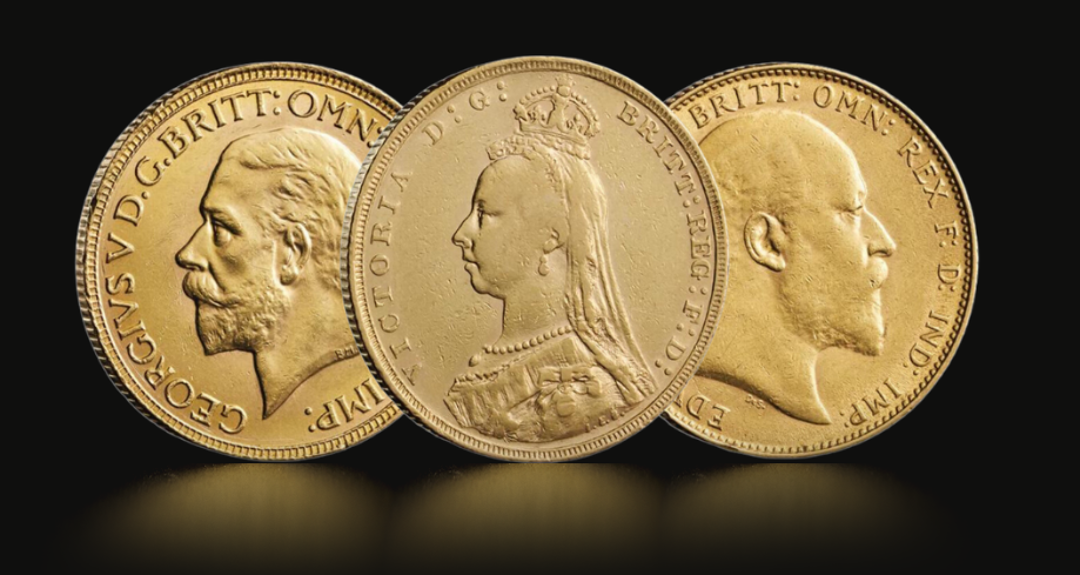
What makes the Victorian sovereign especially interesting for collectors is that three distinct portrait designs were used across her reign, each marking a different stage of her life.
The Young Head sovereign (1871 to 1885) shows a young Queen Victoria with her hair pulled back and plaited into a bun. The inscription around her portrait reads VICTORIA DG BRITANNIA REG FD, which means Victoria, by the Grace of God, Queen of all the Britons, Defender of the Faith.
The Jubilee Head sovereign (1887 to 1893) was introduced to mark her Golden Jubilee, her 50th year on the throne. It shows a more mature Victoria wearing a small crown. The inscription reads VICTORIA DG BRITT REG FD.
The Veiled Head sovereign (1893 to 1901) shows an older Victoria wearing a tiara and a veil, reflecting her later years. The inscription was extended to include her title as Empress of India: VICTORIA DEI GRA BRITT REGINA FID DEF IND IMP.
All three share the same reverse design: St George on horseback slaying the dragon, created by the Italian engraver Benedetto Pistrucci. It remains one of the most beautiful and lasting coin designs in British history.
Tavex treats the three portrait versions the same when supplying Victorian sovereigns. If you have a specific version in mind, please get in touch with the team directly.
Why buy a Victorian gold sovereign?
The Victorian era was when the gold sovereign reached the height of its global influence. By the early 1900s, more than 600 million sovereigns had been minted and sent across the world. They were used by Chinese tea traders, Indian textile merchants, and American cotton sellers. Minting outposts operated in Perth, Bombay, and Pretoria to keep supply in step with demand. The sovereign was the currency of the British Empire.
Owning a Victorian gold sovereign means owning a piece of that history. It is a physical artefact of an era that shaped the modern world. For collectors and investors who value both historical significance and financial merit, it is hard to find anything quite like it.
Buy the Great Britain Gold Sovereign Victoria at Tavex Bullion
The King George V Gold Sovereign (1910 to 1936)
Who was King George V?
King George V was born in 1865, the son of King Edward VII and grandson of Queen Victoria. He acceded to the throne in 1910 and ruled until his death in 1936. His reign covered some of the most turbulent decades in modern history. The First World War, the rise of socialism, communism and fascism, two global depressions, and the beginning of the end of the British Empire as a unified entity all took place during his rule.
Despite the turmoil, George V was widely seen as a steady and inspiring leader. He made more than 400 visits to troops at the front during the First World War. He backed equality, promoted family values, and in 1926 hosted a conference that gave self-governing status to Australia, New Zealand, South Africa, and Canada. The George V sovereign does not just stand for a coin. It marks a moment when Britain and the world changed for good.
The last gold sovereign to circulate
The George V sovereign has a distinction that sets it apart from every other sovereign ever made. It is the last gold sovereign used in day-to-day circulation before Britain left the gold standard.
The First World War forced the UK government to suspend the gold standard to help pay for the war. As part of that effort, the British public was urged to hand over gold coins in exchange for war bonds. By some estimates, gold sovereigns worth about £100 million at the time, equal to roughly £23 billion today, were surrendered to the government. Although some sovereigns were minted again in 1925, they were no longer used in circulation. Continuous production resumed only after 1957.
The George V sovereign therefore marks the final era of the gold sovereign as a working currency. For numismatists and investors alike, that difference carries real weight. These coins were not made to be collected. They were made to be spent. The fact that many survive in good condition is a sign of the depth and liquidity of the sovereign market.
Gold’s price in GBP has risen 220% over the last 10 years. With more than 700 million sovereigns minted since the 1800s, the market for them is deep, liquid, and globally recognised.
Buy the Great Britain Gold Sovereign George V at Tavex Bullion
The King Charles III Gold Sovereign (2022 to present)
The modern sovereign continues the tradition that Henry VII began in 1489. The 2026 King Charles III sovereign marks a notable point in the coin’s history, as the first sovereign to feature the new monarch after the death of Queen Elizabeth II in 2022.
The 2026 edition introduced two major changes. First, it returned to the classic yellow gold alloy, moving away from the rose gold hue that had defined sovereigns since 2000. Second, it added new anti-counterfeit features, including microtext reading HONI SOIT QUI MAL Y PENSE, the historic motto of the Order of the Garter, and a latent image on the obverse that changes shape depending on the angle from which it is viewed.
The reverse keeps Benedetto Pistrucci’s iconic St George and the Dragon design, as used on the sovereign since 1817. The specifications are the same as every sovereign minted since that year: 22 karat gold, 7.98805 grams total weight, 7.32238 grams of fine gold, and a fineness of 916.7.
Like all sovereigns minted after 1837, the Charles III sovereign is CGT-exempt and VAT-free.
Buy the 2026 King Charles III Gold Sovereign at Tavex Bullion
What all three sovereigns have in common
Whatever era a sovereign was made in, the basics stay the same.
- 22 karat gold. Every sovereign contains 7.32238 grams of fine gold at a fineness of 916.7. That consistency across five centuries is one reason the sovereign earned its reputation as the chief coin of the world.
- Legal tender status. All sovereigns minted after 1837 are legal tender in the UK.
- CGT exemption. Because they are legal tender, all gold sovereigns are exempt from Capital Gains Tax in the UK. Any profit made on their sale is not taxable.
- VAT-free. As investment-grade gold, sovereigns are exempt from VAT.
- Global recognition. The gold sovereign is recognised and traded in precious metals markets around the world. Liquidity is rarely a concern.
- Buy-back guarantee. At Tavex Bullion, all gold sovereigns can be sold back at the live market price whenever you are ready.
Historical vs modern: which sovereign is right for you?
The choice between a historical and modern sovereign mostly comes down to what you value beyond the gold content itself.
Modern sovereigns like the 2026 Charles III edition carry lower premiums over the spot price of gold and are usually the choice for investors who want pure gold exposure, maximum liquidity, and the lowest possible premium.
Historical sovereigns like the Victorian and George V editions tend to carry a semi-numismatic premium. They are valued not only for their gold content, but also for their historical significance, their relative scarcity versus modern coins, and their appeal to collectors. Over time, that numismatic element can add value beyond what the gold price alone would suggest.
Both options are CGT-exempt, VAT-free, and eligible for buy-back at the live price. The difference is what you are buying beyond the metal.
Buying historical gold sovereigns at Tavex Bullion
Tavex Bullion has operated from Hatton Garden, London since 1991. We are one of the UK’s longest-established precious metals dealers, with over 2 million customers and a Trustpilot rating that reflects our focus on transparency and service.
All sovereigns are sent in individual plastic capsules, packed securely and discreetly, and shipped fully insured with full tracking provided after dispatch. Free collection is available from our Hatton Garden office.
You can monitor the live gold price at any time and set a price alert if you want to buy at a specific level. Our team is available by phone on 020 4541 4145 or by email at tavex@tavexbullion.co.uk if you have any questions before purchasing.
Browse our full range of historical gold coins or explore the complete British gold coin collection to find the sovereign that is right for you.
Q&A
Question: Are historical gold sovereigns better for investors than modern sovereigns?
Short answer: It depends on what the investor values most. Modern sovereigns, such as the 2026 King Charles III sovereign, usually carry lower premiums and suit buyers who want simple gold exposure with strong liquidity. Historical sovereigns, such as Victorian and George V examples, may carry a semi-numismatic premium because they combine gold content with history, scarcity, and collector appeal.
Question: Why are gold sovereigns tax-efficient for UK investors?
Short answer: Gold sovereigns minted after 1837 are legal tender in the United Kingdom, which makes them exempt from Capital Gains Tax. They are also exempt from VAT as investment gold. This means UK investors can benefit from VAT-free buying and CGT-free gains when they sell.
Question: What makes the George V sovereign historically significant?
Short answer: The George V sovereign is notable because it was the last gold sovereign used in day-to-day circulation before Britain left the gold standard. It marks the final era in which sovereigns worked as currency rather than mainly as investment or collector coins.
Question: Can buyers choose a specific Victorian sovereign portrait from Tavex?
Short answer: Tavex does not separate the Young Head, Jubilee Head, and Veiled Head Victorian sovereigns when supplying them as standard. Buyers who want a specific portrait version should contact the Tavex team directly before purchasing.
Question: Do Victorian, George V, and Charles III sovereigns contain the same amount of gold?
Short answer: Yes. The specifications remain the same for sovereigns minted since 1817: 22 karat gold, 7.98805 grams total weight, 7.32238 grams of fine gold, and a fineness of 916.7.
Gold price (XAU-GBP)
3,137.37 GBP/oz
- GBP20.71
Silver price (XAG-GBP)
44.63 GBP/oz
- GBP1.06