Tavex uses cookies to ensure website functionality and improve your user experience. Collecting data from cookies helps us provide the best experience for you, keeps your account secure and allows us to personalise advert content. You can find out more in our cookie policy.
Please select what cookies you allow us to use
Cookies are small files of letters and digits downloaded and saved on your computer or another device (for instance, a mobile phone, a tablet) and saved in your browser while you visit a website. They can be used to track the pages you visit on the website, save the information you enter or remember your preferences such as language settings as long as you’re browsing the website.
Cookie usage
Necessary cookies
| Cookie name | Cookie description | Cookie duration |
|---|---|---|
| tavex_cookie_consent | Stores cookie consent options selected | 60 weeks |
| tavex_customer | Tavex customer ID | 30 days |
| wp-wpml_current_language | Stores selected language | 1 day |
| AWSALB | AWS ALB sticky session cookie | 6 days |
| AWSALBCORS | AWS ALB sticky session cookie | 6 days |
| NO_CACHE | Used to disable page caching | 1 day |
| PHPSESSID | Identifier for PHP session | Session |
| latest_news | Helps to keep notifications relevant by storing the latest news shown | 29 days |
| latest_news_flash | Helps to keep notifications relevant by storing the latest news shown | 29 days |
| tavex_recently_viewed_products | List of recently viewed products | 1 day |
| tavex_compare_amount | Number of items in product comparison view | 1 day |
Preference cookies
| Cookie name | Cookie description | Cookie duration |
|---|---|---|
| chart-widget-tab-*-*-* | Remembers last chart options (i.e currency, time period, etc) | 29 days |
| archive_layout | Stores selected product layout on category pages | 1 day |
Targeting cookies
| Cookie name | Cookie description | Cookie duration |
|---|---|---|
| cartstack.com-* | Used for tracking abandoned shopping carts | 1 year |
| _omappvp | Used by OptinMonster for determining new vs. returning visitors. Expires in 11 years | 11 years |
| _omappvs | Used by OptinMonster for determining when a new visitor becomes a returning visitor | Session |
| om* | Used by OptinMonster to track interactions with campaigns | Persistent |
Analytical cookies
| Cookie name | Cookie description | Cookie duration |
|---|---|---|
| _ga | Used to distinguish users | 2 years |
| _gid | Used to distinguish users | 24 hours |
| _ga_* | Used to persist session state | 2 years |
| _gac_* | Contains campaign related information | 90 days |
| _gat_gtag_* | Used to throttle request rate | 1 minute |
| _fbc | Facebook advertisement cookie | 2 years |
| _fbp | Facebook cookie for distinguishing unique users | 2 years |

What Is Gold Used For In The Modern World?
Published by honor in category Precious Metal Information Guides on 08.04.2026
Gold price (XAU-GBP)
3,536.60 GBP/oz
+ GBP27.50
Silver price (XAG-GBP)
55.97 GBP/oz
+ GBP2.48

When we hear the word “gold,” we often think of bullion, coins, or jewellery. That association is only natural, gold (and precious metals) has symbolised wealth and value for thousands of years. Yet beyond its cultural and financial significance, this remarkable metal plays a far more essential role in the modern world.
What Is Gold Used for Besides Investment?
Gold is not merely a hedge against inflation or a safe-haven asset in the long term. It is a critical material underpinning today’s technological and scientific progress. Engineers and researchers rely on it for its unique properties:
- Does not oxidise
- Does not degrade over time
- Has excellent electrical conductivity
- Performs reliably in extreme environments
Before viewing gold solely as a financial safeguard, it’s worth exploring the surprising and advanced sectors where it is indispensable.
Gold in High-Performance Technology (Electronics & Microchips)
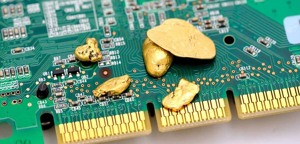
Why Is Gold Used in Electronics?
Modern life depends on microchips. Every electronic device, including the one you’re using now, relies on microprocessors to function efficiently.
Gold is widely used in electronics because it:
- Ensures stable conductivity over time
- Resists corrosion
- Maintains performance under stress
One key application is gold powder in conductive pastes, especially in aerospace and military technologies where reliability is critical.
Breakthrough: Gold Flake Technology
Recent research shows that scientists can produce flat, hexagonal gold particles using a chemical synthesis method instead of mechanical grinding.
Key findings:
- Produced using isopropyl alcohol at 150 °C under pressure
- Creates particles ~5 microns in size
- Forms a uniform crystalline structure
Why Particle Shape Matters
Flat gold flakes:
- Distribute more evenly
- Create more electrical contact points
- Improve conductivity significantly
Result:
Up to 36% higher electrical conductivity compared to traditional spherical particles.
Real-World Impact
- Faster signal transmission
- Lower energy loss
- Increased device reliability
Gold may be invisible inside your device, but it ensures everything works flawlessly, from smartphones to global communication networks.
Gold in the Fight Against Cancer
How Are Gold Nanoparticles Used in Cancer Treatment?
One of the most promising frontiers in medicine involves gold nanoparticles used for targeted drug delivery. These microscopic particles can be engineered to attach directly to cancer cells, delivering treatment precisely where it’s needed while sparing healthy tissue.
They work by:
- Binding specifically to cancer cells
- Delivering drugs directly to the tumour
- Minimising damage to healthy tissue
Key Advantages Over Chemotherapy
Unlike conventional chemotherapy, which affects the entire body, gold-based systems dramatically reduce side effects by focusing only on diseased cells. Additionally, these nanoparticles can be activated by infrared light to generate heat or reactive molecules, effectively destroying cancer cells from within.
- Reduced side effects
- Higher treatment precision
- Improved patient outcomes
Additionally, gold nanoparticles can:
- Be activated by infrared light
- Generate heat to destroy cancer cells
- Produce reactive molecules that trigger cell death
Research Results
Studies show promising outcomes in:
- Breast cancer
- Lung cancer
- Brain tumours
- Pancreatic cancer
In one study, combining gold nanoparticles with radiation therapy more than doubled survival time in animal models of pancreatic cancer.
Example:
A 2024 study found that combining gold nanoparticles with radiation therapy increased survival from 102 days to 235 days in animal models.
Future Potential
Scientists are also exploring how gold can enhance radiotherapy itself, allowing for lower radiation doses while maintaining effectiveness, thereby reducing damage to healthy tissue.
Gold and the Blood-Brain Barrier
Can Gold Help Treat Brain Diseases?
Yes, gold nanoparticles are emerging as a solution to one of medicine’s biggest challenges: the blood-brain barrier.
This barrier blocks most drugs from entering the brain, making these diseases difficult to treat:
- Alzheimer’s
- Parkinson’s
- Brain tumors
How Gold Solves This Problem
Scientists attach gold nanoparticles to molecules like L-DOPA, which the brain naturally recognises.
This allows them to:
- Cross the blood-brain barrier
- Deliver drugs directly into brain tissue
Breakthrough Applications
In experimental studies, gold particles have successfully reached brain regions affected by conditions like Alzheimer’s disease.
Once there, they can serve both as treatment carriers and as imaging agents, allowing doctors to monitor disease progression in real time.
In Parkinson’s research, gold nanoparticles have already demonstrated the ability to deliver drugs that were previously difficult to administer effectively. While still under development, these approaches could revolutionise treatment for neurodegenerative diseases in the near future.
- Alzheimer’s: gold accumulates in affected brain regions and enables imaging
- Parkinson’s: successful delivery of drugs like pilocarpine
- Real-time monitoring of disease progression
These innovations are currently in advanced research stages, with clinical trials expected in the near future.
Gold in Rapid Diagnostics

If you’ve ever taken a rapid test for COVID-19, flu, or hepatitis, you’ve already seen gold in action.
The visible line indicating a positive result is created using colloidal gold nanoparticles. These particles exhibit a unique optical behaviour: when they cluster together, they produce a distinct red or purple colour visible to the naked eye.
Here’s how it works:
- A biological sample binds to gold particles coated with specific antibodies
- The complex moves along the test strip
- It is captured by another set of antibodies
- The accumulation of gold creates the visible test line
This simple yet powerful mechanism allows for accurate results in just 10–15 minutes, without the need for complex equipment. These tests are affordable, easy to use, and have long shelf lives, making them especially valuable in regions with limited healthcare infrastructure.
Researchers are now working to enhance these systems further, integrating artificial intelligence and enabling the detection of multiple pathogens from a single sample, with dramatically improved sensitivity.
Gold in Space Exploration

Gold even plays a role in exploring the universe.
The James Webb Space Telescope, the most advanced astronomical instrument ever built, uses gold to observe the earliest galaxies in existence. Its primary mirror consists of 18 hexagonal segments coated with an ultra-thin layer of gold, just 100 nanometers thick.
Gold was chosen for its exceptional ability to reflect infrared light, achieving over 98% efficiency, better than any alternative material. This allows the telescope to capture incredibly detailed images of objects formed nearly 13.5 billion years ago.
In essence, gold helps humanity look back in time, unlocking the secrets of the universe’s origins.
Read more on the topic: Gold and Space: Do We Have a Chance to Find Gold Beyond Our Planet?
Conclusion
Gold’s physical and chemical properties make it indispensable across a wide range of industries, from electronics and medicine to diagnostics and space exploration.
These same properties also explain its enduring economic value. Gold is not only a symbol of wealth but a functional cornerstone of modern innovation.
It coats the mirrors that study the cosmos, delivers life-saving treatments to cancer cells, enables rapid disease detection, and ensures the reliability of the devices we depend on daily.
Gold is not just a relic of the past, it is a critical material shaping the future.
Frequently Asked Questions
In which sectors is gold used outside of finance?
Gold is essential in electronics, medicine, diagnostics, and space technology. It is used in circuit boards, targeted drug delivery systems, rapid diagnostic tests, and telescope mirrors.
Why is industrial demand for gold increasing?
As technology advances, gold’s unique properties make it increasingly valuable in high-tech applications. This growing industrial demand complements its traditional role as an investment asset.
What is colloidal gold?
Colloidal gold consists of microscopic particles that change color when they cluster together. This property is used in rapid diagnostic tests to produce visible results.
Why does gold retain its value over time?
Gold does not corrode or degrade. Its durability and reliability, combined with its critical role in advanced technologies, make it a stable store of value in uncertain economic conditions.
Gold price (XAU-GBP)
3,536.60 GBP/oz
+ GBP27.50
Silver price (XAG-GBP)
55.97 GBP/oz
+ GBP2.48